News
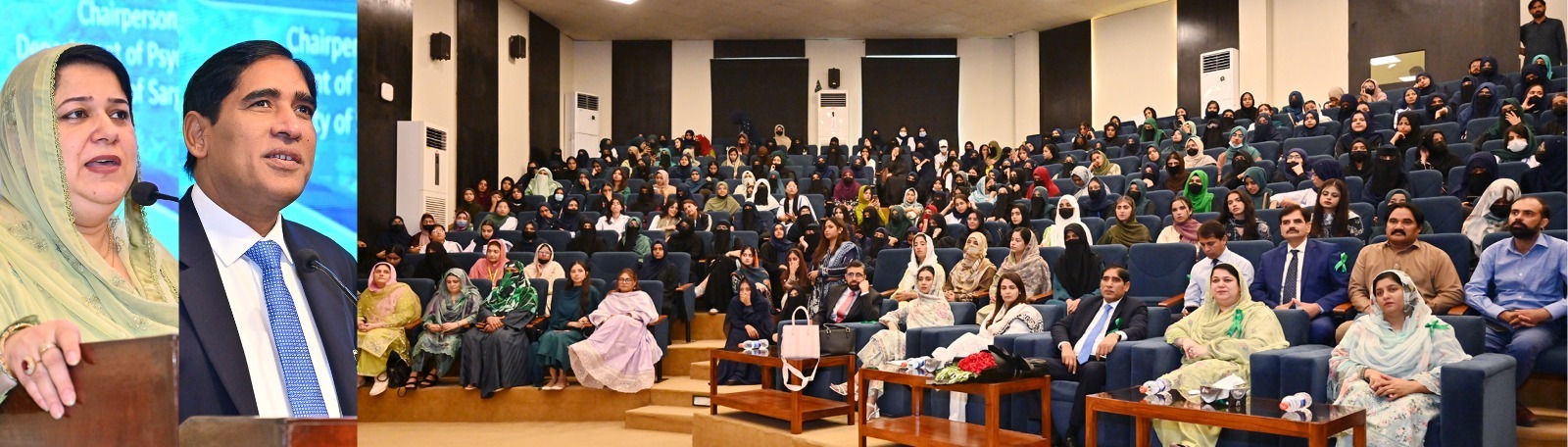
The University of Sargodha marked World Mental Health Day with a series of awareness activities organized by Counseling Center and Department of Psychology, bringing together academic leaders, mental health professionals and students to discuss the growing psychological challenges facing society.
A seminar and a Workshop on Lived Experiences and Mental Health were held at the Malik Feroz Khan Noon Business School, with Vice Chancellor Prof. Dr. Tasawwar Hayat (Hilal-i-Imtiaz, Sitara-i-Imtiaz and Tamgha-i-Imtiaz) as the chief guest. Pro Vice Chancellor Prof. Dr. Masood Sarwar Awan also attended the event.
Addressing the gathering, the Vice Chancellor emphasised that the mental well-being of citizens, particularly young people, is essential for national progress and social development. He called for greater engagement in healthy activities and efforts to counter extremism and negative attitudes through empathy, tolerance and mutual understanding.
He highlighted the role of extracurricular competitions and artistic activities in educational institutions, noting that such initiatives contribute to students’ intellectual development and psychological well-being. He also stressed the importance of coordination, compassion and a supportive social environment in addressing emerging mental health challenges.
Chairperson of the Department of Psychology, Prof. Dr. Najma Iqbal Malik, described mental health as a fundamental human right and highlighted the department’s efforts to promote psychological well-being through education, research, and student counseling. She said active listening, open communication, and continuous learning were essential to building a supportive environment for mental health.
The seminar featured expert discussions on several critical issues. Dr. Khawaja Arshad highlighted the increasing recognition of autism among children, stressing the importance of early intervention and parental awareness. Dr. Shamshad Bashir discussed how social support networks can improve the lives of individuals experiencing mental health challenges.
Psychologist Asma Irfan addressed the social and psychological factors associated with suicide, emphasising the importance of community support and timely intervention. She also underscored the influence of parents’ psychological well-being on the mental and physical development of children.
Students contributed to the program through creative performances, videos and documentaries designed to promote awareness and encourage constructive conversations about mental health.
In addition to the seminar, awareness stalls were established at the Department of Psychology to disseminate information and engage students in discussions on psychological well-being. Faculty members and a large number of students attended the activities.